
Emergency Planning
EMERGENCY PLANNER: ALYSSA SABETTO
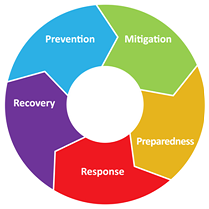
The WRC aims to provide useful and creative tools to assist our member towns with each stage of emergency management: prevention, preparation, response, recovery and mitigation, though most of our work is in preparation and mitigation. We are a resource to towns in their response role and a linkage to state and federal resources before, during and after times of emergency. The WRC provides guidance to towns with meeting emergency planning requirements set at the state and federal levels, as well as initiatives that towns voluntarily take to make their residents and visitors safer and more resilient to all hazards.
Below are resources and helpful information to guide and support emergency planning efforts in your town. Questions related to emergency planning should be directed to Alyssa Sabetto at 257-4547 extension 113 or asabetto@windhamregional.org.
FLOOD RECOVERY RESOURCES
Things towns should be doing now:
- Appoint an Emergency Management Director, Coordinator, or both.
- Update the Local Emergency Management Plan (LEMP) every year.
- Complete the LEMP appendices. These enhance the usefulness of the LEMP.
- Maintain an up-to-date Local Hazard Mitigation Plan.
- Adopt river corridor protection in flood hazard bylaws and in town plans. See below on this page for WRC guidance.
- Be aware that FEMA is updating Special Flood Hazard Area mapping statewide. Learn about where your town/watershed lies in that process here and stay engaged when draft maps are available for comment.
- Obtain a satellite phone, or a sim card that enables satellite capability on a non-satellite phone, along with a solar charging device for use during long term power outages.
- Identify a local shelter for your community. Have written agreements in place with shelter partners. Keep supplies on site (bottled water, first aid kit, extra toilet paper, sanitation supplies). Check supplies and agreements annually.
- Put an emergency preparedness line item in the town budget (to pay for things like the stash of toilet paper, sandbags, or gas for the generator).
- Have mutual aid MOUs in place before they are needed. Review them annually.
- Divide your town into geographical segments and identify a key point person in each segment that can be called upon to coordinate with the EMD during periods where access or power may be limited or non-existent for a long length of time. Communicate with those contacts to ensure they agree to act in that role should the need arise. Fuel shortages should be considered possible.
- Take advantage of mitigation grant opportunities to decrease risk in your town.
- Work with the Road Foreman to set up Mutual Aid agreements with surrounding towns. The Rutland Regional Planning Commission has put together a template agreement specific to public works, along with an Aid Request Form and a Designated Officials Contact Form.
- Engage residents! Use tools like Front Porch Forum, or a town newsletter to remind neighbors about shelter locations, family preparedness, and to keep them apprised of what your community is doing to be better prepared.
- Consider how your town would confront a disaster that doesn’t receive federal support through a federal disaster declaration. These are some things towns can do to prepare for that potential:
- Establish a dedicated disaster reserve fund.
- Establish lines of credit before a disaster ever strikes.
- Learn about public financing tools and options for mitigation projects, recovery and rebuilding.
- Develop a capital improvement plan and related budget to identify and prioritize projects. At a minimum this could be a prioritized bulleted list with reasonable cost assumptions.
- Use your town plan and your local hazard mitigation plan to inform your capital improvement planning.
- Give serious consideration to what infrastructure must be rebuilt and what can be abandoned if damaged or destroyed, also known as “strategic abandonment.”
In a disaster
Important contacts to have handy:
- State Watch Officer 1-800-347-0488 Resources and support beyond what is locally available.
- ANR (802) 490-6195 Emergency Protective Measures for Instream Work
- VTrans District 1 (802) 447-2790 // District 2 (802) 254-5011 Bennington, Brattleboro
- Windham Regional Commission (802) 257-4547 Reporting damage information
- American Red Cross 1-800-464-6692 Humanitarian support
- HazMat Hotline 1-800-641-5005 To report hazmat emergencies
Tier II reporting requirements for Vermont changed in 2022. Windham Regional Commission no longer accepts Tier II reports. There is now a statewide LEPC to accept reports. Please submit electronically to all required receivers. Tier II reports are required to be filed annually by March 1st to the following three entities:
- Your local responding fire department.
- The State Emergency Response Committee (SERC) using their Tier II Portal.
- The new statewide Local Emergency Planning Committee (LEPC).
You can find more information here and direct all technical and reporting questions to the statewide LEPC email: DPS.StatewideLEPC@vermont.gov
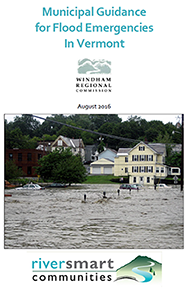
The Municipal Guidance for Flood Emergencies in Vermont document shares actions and steps to be taken by each local role at each flood stage: from proactive and smart advance preparations, to advance preparations to do when a major storm is forecast, and on to actions to be taken during the storm, as well as during recovery. This comprehensive guide is meant to be an active tool that is kept both electronically and in hard copy with your Local Emergency Management Plan. Numerous state and federal agencies had input into the creation of the Flood Guide. Our goal is that towns will share this guide both internally and with their neighboring towns, to foster resiliency throughout Vermont. The Flood Guide is available electronically here, and on WRC’s Documents page. Hard copies are also available at request by contacting Alyssa.
There are several options for towns interested in updating their flood hazard bylaws. WRC has developed Model Flood and Fluvial Erosion Hazard Regulations that we can share with interested towns. As well, Vermont ANR has a customizable model bylaw. Towns can also develop their own bylaw, so long as it meets the National Flood Insurance Program (NFIP) standards. Having River Corridor regulations in your bylaw will enable your town to qualify for an increased state Emergency Relief Assistance Fund (ERAF) match of 17.5%, so long as you meet the base 12.5% ERAF criteria beforehand.
Model bylaws are not meant for adoption without customization, review and approval. We recommend that you work with us or the Vermont Agency of Natural Resources on updating your regulations. This is to ensure compliance and understanding of the regulations, as well as a complete understanding of what the optional components are and what they mean on the ground. Please review the options and reach out to Alyssa Sabetto at asabetto@windhamregional.org with questions or to start the update process.
What can we do now to lower our risk before disaster strikes? This is the basis of Hazard Mitigation Planning.
A disaster resilient town is designed to be in harmony with the natural environment as much as possible so that risk to human life, animal life, and the built environment is minimized, thus causing less disruption to social and economic facets of the community when disaster strikes.
A Hazard Mitigation Plan is a tool for organizing ideas and developing strategies for implementing mitigation measures in your town. This results in less post-disaster loss, recovery time and expense for the town and its residents. For more information on Hazard Mitigation Planning can be found in this informational overview. To learn what your town has done about mitigation planning, please contact Alyssa Sabetto at (802) 257-4547 ext. 113 or asabetto@windhamregional.org.
ERAF provides state funding to match FEMA Public Assistance after federally-declared disasters. Eligible public costs are reimbursed by federal taxpayers at 75%. The state contributes a portion of the required 25% non-federal match for approved projects, based on towns ERAF compliance level. Towns are required to meet four basic measures to get a 12.5% match from the state. Towns that adopt higher standards can achieve a higher percentage of state funding for post-disaster repair projects – from 12.5% to 17.5%. Towns that have not adopted the basic set of measures receive a decreased state match of 7.5%. Thus, the state contribution toward the local match requirement will vary from 7.5% to 17.5% of the total project costs, depending upon the level of adoption of recommended mitigation measures. Contact Alyssa Sabetto for questions and assistance maximizing your ERAF state match.
What is needed for ERAF compliance?
12.5% – eligible communities have adopted four mitigation measures:
- Adopt or take steps toward the adoption of a flood hazard bylaw adequate enough to secure participation in the National Flood Insurance Program (NFIP);
- Adopt the most recent Agency of Transportation Town Road and Bridge Standards, available from VTrans;
- Adopt and maintain a Local Emergency Management Plan (adopt annually after town meeting);
- Adopt a FEMA approved Local Hazard Mitigation Plan (valid for five years). Or, a draft plan has been submitted to Vermont Emergency Management for review.
17.5% – eligible communities also:
- Adopt a river corridor protection bylaw that meets or exceeds state model regulations and guidelines (you can use the WRC model or the VT Agency of Natural Resources model to meet this standard); OR
- Maintain an active rate classification under FEMA’s NFIP Community Rating System (CRS) that includes activities that prohibit new structures in mapped flood hazard areas.
After a declared disaster the damage to public infrastructure including roads and culverts may approach a million dollars. Here is how the cost of damage will be carried by federal, state, and municipal taxpayers:
| 7.5% ERAF Rate | 12.5% ERAF rate | 17.5% ERAF Rate | |
| Federal Share | $750,000 | $750,000 | $750,000 |
| State Share | $75,000 | $125,000 | $175,000 |
| Municipal Share | $175,000 | $125,000 | $75,000 |
| 100% of $1,000,000 | $1,000,000 | $1,000,000 | $1,000,000 |
Not sure what your town’s ERAF rate is or what ERAF criteria have been met? Check on the FloodReady website.
It is vital to consider evacuation planning for both people and animals prior to the need for a large scale evacuation. Town Officials and residents alike should know what steps to take and how to evacuate, so that an evacuation can happen as smoothly as possible. Having an Evacuation Plan in place is one way to accomplish this.
The WRC has developed a town scale Evacuation Plan template that is available here to download (Word document). This template is meant to be an opportunity for towns to create an evacuation plan and evacuation mapping. In doing so, keep in mind that it is pivotal to talk with the larger facilities present in your town, including, resorts, medical facilities/clinics, schools/daycares, developments, and those who may need special assistance during an evacuation. This serves to coordinate evacuation planning and set expectations beforehand so no one is left wondering who will do what when. In creating your plan and mapping, consider creating a front/back handout with information and mapping (See appendix 4 of the template for an example) for residents to have should an evacuation be necessary. The Evacuation Plan template contains general guidance information that would be relevant to all towns in advance of and during an evacuation, as well as space where towns should add specifics for their own purposes. There are eight appendices included that should be specified for your town to be of use.
The WRC has also developed an Animal Resources appendix and guidance document for the Local Emergency Management Plan that addresses planning for and caring for companion and domestic animals during a disaster. This document is meant to encourage consideration and planning for animals in a municipality by determining such things as where they can shelter, who can offer emergency veterinary care, and where there are animals at high risk during disasters. Vermont has the largest per capita rate of pet ownership in the country, with 71% of households claiming to have pets, so it’s likely that pet owners and animal-related business owners will turn to their EMDs and towns for assistance during times of crisis. Having the information on this form pre-determined and available during a disaster will enable town officials to answer questions, give direction and make connections quickly and easily.

Both of these documents are also model appendices (B7 and B9) in Vermont Emergency Management’s Local Emergency Management Plan.
If your town already has an evacuation plan and evacuation mapping developed, please let Alyssa know. Also, make this an opportunity to review and update your current plan. Does your plan contain the elements in the attached template? Have you recently talked with and coordinated evacuation planning expectations with the relevant facilities and parties present in your town? Do you have evacuation mapping developed, and have you shared that with your residents so they are educated about this issue? These are some considerations to make in reviewing your current evacuation planning efforts.
If you have questions, or would like us to review a plan with you, or for assistance in developing an evacuation plan, please contact Alyssa at asabetto@windhamregional.org or 802-257-4547 ext. 113.
The WRC staffs the Regional Emergency Management Committee (REMC), though it is separate entity from the WRC. The REMC meets quarterly and its function is to provide a regular networking and learning opportunity for Emergency Management Directors (EMDs), Fire Chiefs and those actively involved in the emergency management community. Each town can appoint up to two members, one of which is automatically the EMD. The REMC promotes open dialogue and relaxed discussion among attendees, while working to actively address issues raised by the members.
Quarterly sessions are meant to provide EMDs, Fire Chiefs and Police officials an opportunity to skill share with each other, learn from each other, learn about new and emerging emergency management topics, network, and get direct feedback from their counterparts about issues they are facing in their roles or their towns. If you’d like to learn more, please contact Alyssa at asabetto@windhamregional.org or 802-257-4547 ext. 113.