From the Director, February 2026: Impacts of FEMA Putting Emergency Planning Funding on Hold
For this newsletter I’m sharing a letter I sent on behalf of Vermont’s 11 regional planning commissions to the Senate Natural Resources Committee explaining how FEMA’s suspension of the Emergency Management Performance Grant has impacted the ability of the RPCs to support town emergency planning and preparedness, and the overall statewide emergency planning and response framework. This is some of the most important support we provide to towns and the state, and it is at risk.
January 13, 2026
Dear Chairperson Watson:
I’m writing to the Senate Committee on Natural Resources and Energy in my capacity as Executive Director of the Windham Regional Commission (WRC) and Chair of the Vermont Association of Planning and Development Agencies (VAPDA) Emergency Planning Committee to describe the impacts of federal funding delays and cuts to our support of emergency planning at the local and state levels. Because FEMA has delayed approval of Vermont’s application to the Emergency Management Performance Grant Program (EMPG), and been unclear about requirements to be met by Vermont’s 11 regional planning commissions (RPCs) as subgrantees, much of our work in support of municipalities and in collaboration with Vermont Emergency Management has been sidelined with no resolution on the horizon.
The role of Vermont’s RPCs in Vermont’s emergency preparedness, response, and recovery was effectively redefined in the wake of Irene when we were tasked with supporting municipal recovery as the state was consumed with rebuilding its own assets. Irene highlighted the deep relationships RPCs have with the municipalities we serve, and across agencies and programs including emergency management, transportation, and natural resources. The roles we assumed and the work we did led to our being fully integrated into the state’s emergency planning, response and recovery framework. We support local emergency and mitigation planning and action, serve as local liaisons between municipalities and the State Emergency Operations Center (SEOC), and serve in the SEOC in GIS and planning support functions. We have also committed to have at least one staff person trained as a Certified Floodplain Manager to assist municipalities with participation in the National Flood Insurance Policy Program. Our function in the state’s emergency planning and disaster mitigation and recovery framework is now at risk.
The purpose of the FEMA EMPG program is to assist state and local governments in enhancing and sustaining all-hazards emergency management capabilities. FEMA provides the funding to local jurisdictions through the states. Each year VEM and the RPCs agree upon a common scope of work that follows FEMA guidelines. Because of the FEMA EMPG delay, and the suspension of other federal emergency and mitigation funds, the following are some of the tasks normally performed by RPCs that have effectively been sidelined:
- Being the technical assistance provider for towns for most things related to emergency management, planning, and hazard mitigation, and supporting state initiatives related to implementation of the same.
- Emergency Relief Assistance Fund (ERAF) check-ins and assistance to towns with meeting state standards.
- Organizing trainings and exercises for organizations, fire departments, emergency management directors (EMDs), and municipalities.
- Developing grant applications for mitigation and emergency management projects.
- Developing Local Hazard Mitigation Plans.
- Taking emergency management trainings to enhance staff capacity for emergency management work.
- Providing technical assistance to municipalities dealing with floodplain permitting questions (which further burdens DEC floodplain staff).
- Staffing the Regional Emergency Management Committees and attending the meetings.
- Helping on-board new EMDs
- Dam-related emergency management coordination.
- Supporting execution of projects in the State Hazard Mitigation Plan.
The sidelining is also impacting, or will impact:
- Our assumed role in implementing elements of the Flood Safety Act related to river corridors, dam safety, and flood hazard bylaws.
- Support for the Resilience Implementation Strategy.
- Support for the roll out of resilience planning tools by the Climate Action Office.
- Support of initiatives and actions of the state Office of Disaster Recovery.
- Continued support of municipal hazard mitigation project development, including buyouts.
Perhaps the biggest risk is potential diminishment or loss of the relationships we have built with and among municipal emergency managers and their respective frameworks over the last decade and a half. This could in turn result in increased inequities and reduced local readiness: loss of regional support disproportionately impacts smaller and rural municipalities, reducing preparedness functions such as continuity of operations, sheltering, special populations planning, volunteer management, hot/cold weather planning, and local emergency operations center support.
The RPCs are committed to doing whatever we can to provide some base level of service to the communities we serve because of the responsibility we feel towards the relationships we’ve built, but also because this is the area of our work that is most directly related to life and safety. We’ll have greater insight into what this might look like as the realities of our larger funding outlook emerge, but the sidelining of the EMPG is already resulting in the loss of our capacity to do what is arguably the most important work our communities expect of us.
Please let me know if you have any questions. I or my colleagues would also welcome the opportunity to appear before the Committee.
Sincerely,
Chris Campany, Executive Director
Chair, VAPDA Emergency Planning Committee
|
|
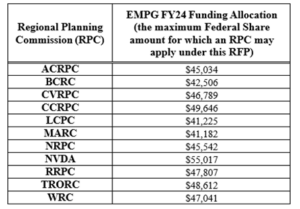
This is the funding allocation from the most recently executed EMPG funding round. The $47,041 allocated to the WRC translated into a total of approximately 400 federally funded staff hours, matched by another 400 non-federally funded staff hours, for a total of 800 staff hours in support of emergency planning in our region between 10/1/24 and 9/30/25. |